

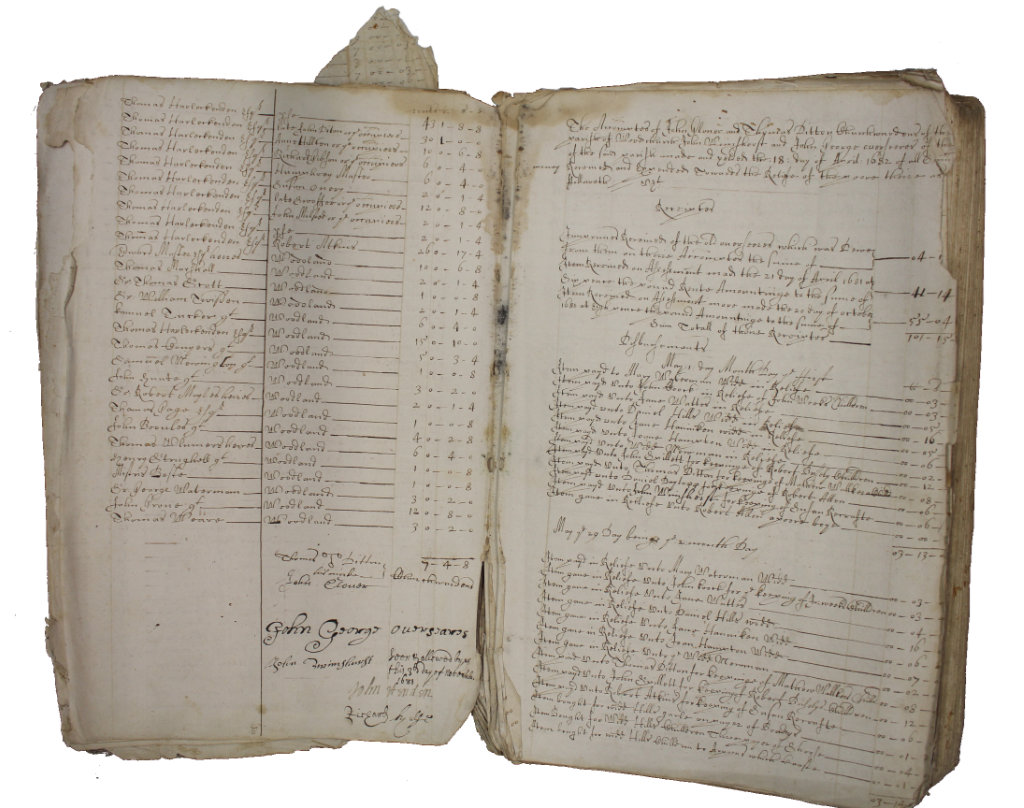
If you fell on hard times in the past, there was no help from the government. If you were unable to feed and clothe yourself for whatever reason, the only way to get help was to apply to the overseers of the poor in your own parish. Only if they thought you were deserving of help, would you get it. Sometimes this was a cash payment, but more often than not, you would be given help in the form of food, fuel, clothing, housing or medical assistance. So many of the Woodchurch shopkeepers, farmers and tradesmen were paid to supply such things as meat, sacks of flour, logs and faggots to keep warm by and to cook with, and material to make clothes. If you couldn’t make your own clothes, as in the case of children, then women of the village were paid to sew or knit garments for you. So the economy was kept ticking.
However, not all items required could be found in the village shops and the overseers had to purchase things from elsewhere. In October 1695 there is a bill in the overseers’ records which was sent in by a Mr Furbee of Tenterden. Throughout the year Mr Furby (to give the more usual spelling) had supplied the Woodchurch poor with a large assortment of drapery goods: linens white and coloured, buttons, tape, hatbands and linings and other things, his total bill coming to £6 12s 9d (£6.64).
Mr Furby was actually the grocer and draper Richard Furby who was working in partnership with his grandmother and mother in a shop which, according to Hugh Roberts, was on the site of the building on Tenterden High Street just the east of the present town hall.

Furby’s grandmother, Susan Butler, had run her shop for at least thirty years. She had lately been in partnership with her son-in-law, John Furby, but he had died the previous November, so she now worked with her daughter Rebecca and grandson Richard. The shop was large, containing about a dozen rooms over two floors, and it was a grocery and drapery, selling medicines, cheeses, currants, liquorice, ginger, glue, candy and brimstone, tobacco, lanterns, nails, looking glasses and much else besides.
Susan left an interesting will, written in 1694. Apart from mentioning a son who was living in Virginia, she also left £100 to Richard Furby and her other two grandchildren. However, two years later Richard’s behaviour had compelled her to change her mind. Roberts says, ‘But whereas Richard ffurby […] is now an ill husband & negligent in his business more likely to spend then improve an estate, I only give him the sume of five shillings’. The £100 could be paid ‘if at any time my executrix shall see such reformacon of life in the said Richard that there be hopes of his improveing it to his advantage’.1 What Richard had done to earn such treatment, we do not know, and sad to say, both he and his grandmother died of smallpox two years after the codicil was written. Hopefully, they had made their peace with each other before then.
Footnote
- Hugh Roberts, Tenterden: The First Thousand Years (Wilton 65, 1995), p. 185. ↩︎