
While carrying out some research on the Royal Military Canal, I came across a fascinating map produced by the Historical Section of the Cabinet Office in 1954 regarding Woodchurch and Operation Sea Lion1.
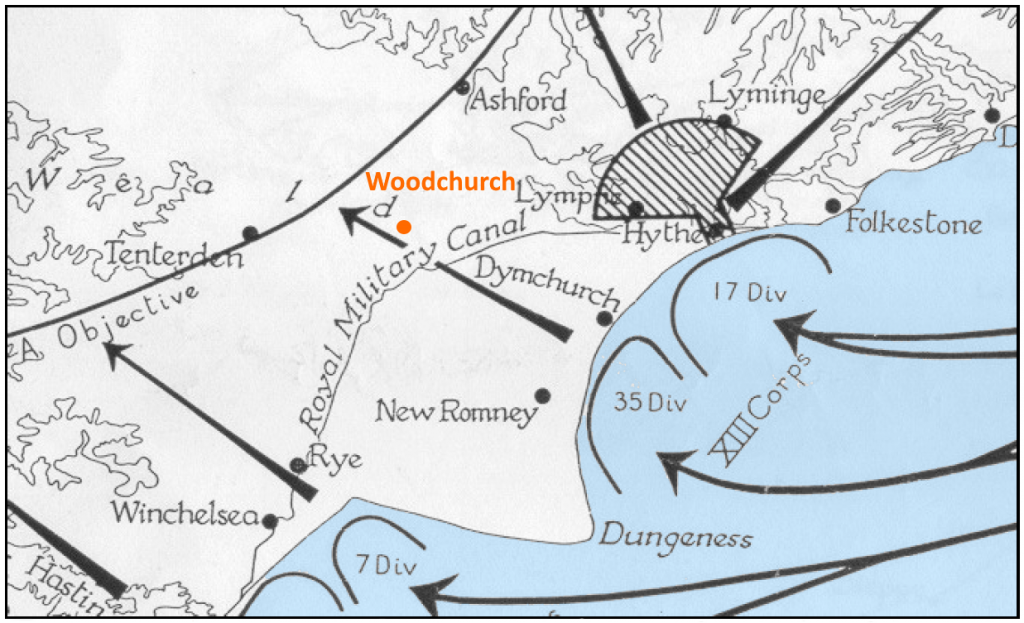
The map of Defence Area 36 shows Woodchurch (not labelled on the original) in the frontline of Operation Sea Lion, Hitler’s plan to invade Britain in 1940. As part of a much larger invasion all along the south coast between Kent and Sussex, two heavily equipped divisions of the German 16th Army’s XIII Corps – the 17th and 35th Infantry Divisions – would have crossed the English Channel from concentration areas on the northern coasts of France and Belgium. With support from the German Luftwaffe and navy, these assault troops would have come ashore on the beaches between Folkestone and Dungeness. Other divisions would have landed at Brighton, Eastbourne, Bexhill, Hastings and Winchelsea. At full strength, the 17th and 35th divisions alone would have fielded a combined total of almost 36,000 men. In all, the first wave of the German landing comprised eleven well-trained infantry divisions.
Once the leading divisions had established a beachhead and landed sufficient troops ashore, the next phase involved an offensive move inland. But this would not have gone unopposed. The first obstacle was a nineteenth-century defensive waterway.
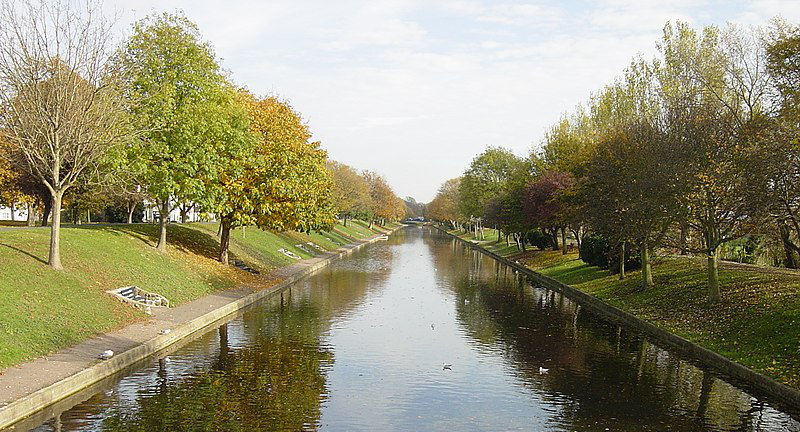
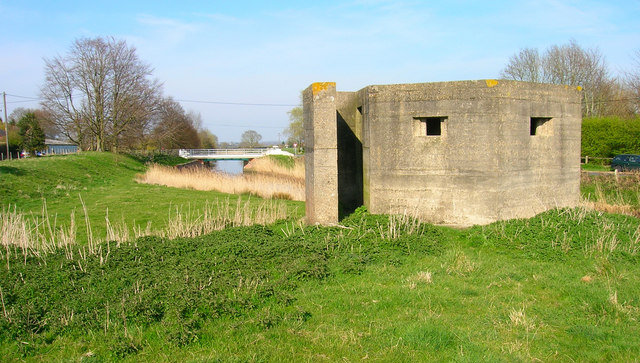
The Royal Military Canal, completed in 1809 to prevent Napoleon’s invasion, would have been the first major barrier the German troops encountered. Reinforced concrete pillboxes, barbed wire entanglements and extensive minefields fortified the canal on the southern approach. The British Army heavily defended Romney Marsh from June to October 1940, when an invasion was most expected. Royal Engineers packed explosives into bridges over the canal ready for demolition. Heavy artillery units occupied positions on the higher ground to the north to cover the beaches and main approaches to the canal. It is still possible to see a few of the remaining pillboxes along stretches between Bilsington and Ruckinge.
As soon as the infantry had breached the canal defences, the 35th Division would have headed straight for Woodchurch, forcing a wedge between Tenterden and Ashford.
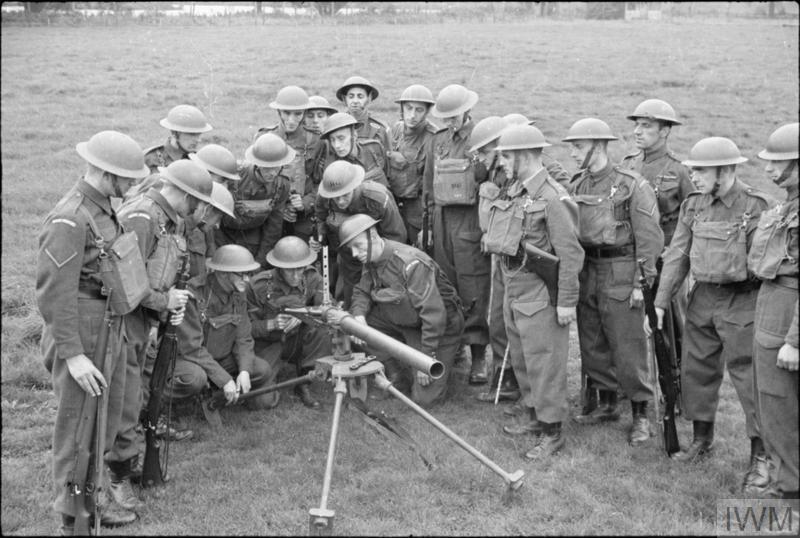
Towns and villages in the area were defended by the regular army, assisted by battalions of the Kent Home Guard. Secretive Auxiliary Units would also disrupt the enemy’s progress2. Organised into patrols, each of these special units consisted of a small team of between four and eight men with excellent knowledge of their local area. The men were typically farmers, farm labourers, gamekeepers, drivers, mechanics and engineers. Their task was to hamper the advancing troops using sabotage, assassination and demolition, breaking supply lines and causing as much disruption as possible. John Weller (1904–1975), who farmed at Hengherst, was an active member of one of the local patrols. Men in an Auxiliary Unit had an operational life expectancy of just twelve days. They were also under strict instructions not to be captured alive.
The first days and weeks of the invasion would have seen the widespread arrest and imprisonment of local officials. Mirroring the earlier occupations of Belgium, France and the Netherlands. Summary execution of civilians in public—on village greens and in market squares—was also likely, especially if there was any resistance. Terror and brutality were central to subduing the morale of populations in German-occupied territories.
However, for any invasion of southern England to succeed the Germans needed both air and naval superiority. Without this, their ships, invasion barges and troops would be easy targets in the Channel and on the beaches. The Luftwaffe made repeated attempts to destroy RAF aircraft, airfields, and production sites during the Battle of Britain (July–October 1940). However, the skill and bravery of RAF fighter pilots denied the Germans air superiority. As a result, Hitler postponed Operation Sea Lion indefinitely. The 17th and 35th divisions were transferred to Poland in April 1941. There they trained for Operation Barbarossa, the invasion of the Soviet Union. Both would go on to commit war crimes against Polish and Russian civilians.
With the threat of invasion over, Woodchurch later played an important part in the Normandy landings of 6 June 1944. An Advanced Landing Ground was constructed north of the village. US fighters flew sorties from this airfield against targets of opportunity in northern France. They also provided top cover for Allied troops disembarking onto the beaches.
Several alternative histories – books, films, and television series – have attempted to construct a post-war Britain in which Nazi Germany successfully invaded Britain and won the Second World War. The most recent of these is a BBC adaptation in 2017 of Len Deighton’s novel SS-GB.
In summary, had Nazi Germany succeeded in its aim to crush the RAF and Royal Navy in 1940, life in Woodchurch would have taken a very different course.
Footnotes
- William Foot, Defence Areas: A National Study of Second World War Anti-Invasion Landscapes in England [Data Set] (York: Archaeology Data Service, 2009) <https://doi.org/10.5284/1000032>. ↩︎
- Coleshill Auxiliary Research Team (CART), ‘Auxiliary Unit Patrols’ <https://www.staybehinds.com/auxiliary-unit-patrols> [accessed 6 June 2021]. ↩︎
Facinating,, thanks Gary and team for all your valuable research and information.
So valuable.