
Twenty-five Years of the Woodchurch Village Life Museum 2001–2026
This year, the Woodchurch Village Life Museum celebrates its silver jubilee. Founded by Geoff Loynes and officially opened by Joanna Lumley in 2001, the year of celebration starts with a two-day exhibition over the weekend of 21–22 February 2026 in the Woodchurch Memorial Hall. The exhibition will feature highlights from the Museum’s collection, including this Victorian slide projector.
Magic Lanterns
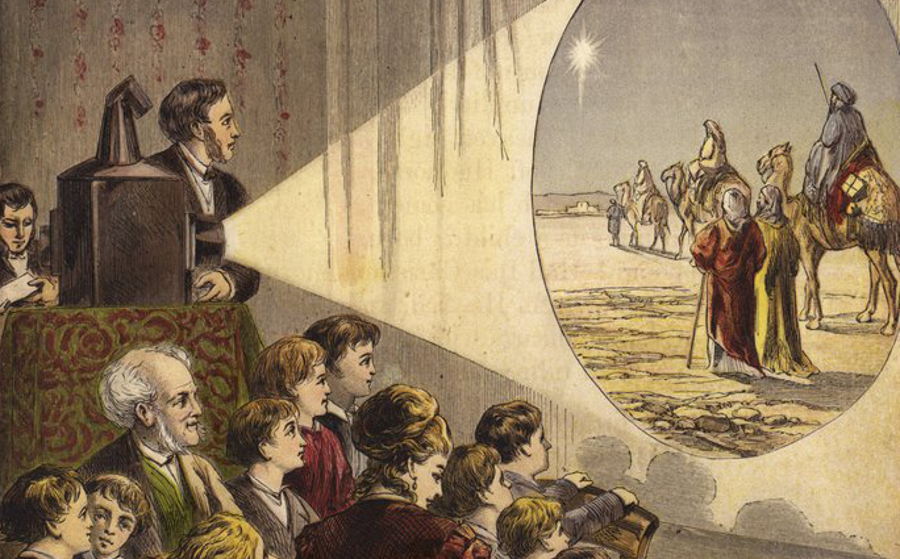
Lantern projectors, better known as magic lanterns, have been in use since the mid-seventeenth century. They came in all shapes and sizes. Some were toys or only for home use, but improvements to lenses, mirrors and light sources eventually allowed images to be projected that could entertain larger audiences. Special effects could be achieved using two or three lanterns stacked on top of one another or lantern slides with movable parts. They provided popular visual entertainment before the advent of cinema and were also used for moral instruction and education.
The Woodchurch Lantern
In contrast to the more expensive lanterns with mahogany or oak light chambers, lined with metal to mitigate fire risk, ours is primarily made of metal. The chamber and chimney lift off to allow access to what would probably have been a paraffin burner, although some lanterns used the more dangerous limelight, which was potentially explosive.1 Ours has been adapted to take an electric light bulb. The lens cover and ring around the condenser lens are made of brass. The objective lens is mounted on a wooden front plate, which is linked to a bellows for focusing. The 3¼ x 3¼-inch (82.55mm square) glass slides would have been inserted into a wooden holder. Our lantern lacks its original base and may have been used latterly as a spotlight in the Memorial Hall, where it was found in a cupboard.
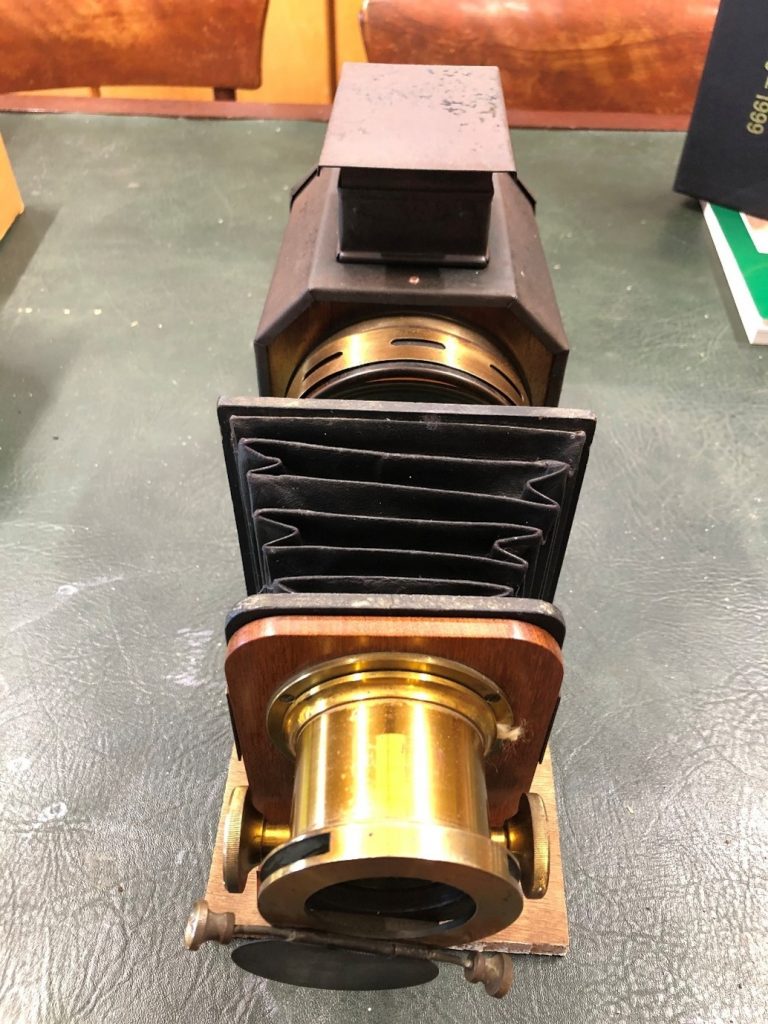
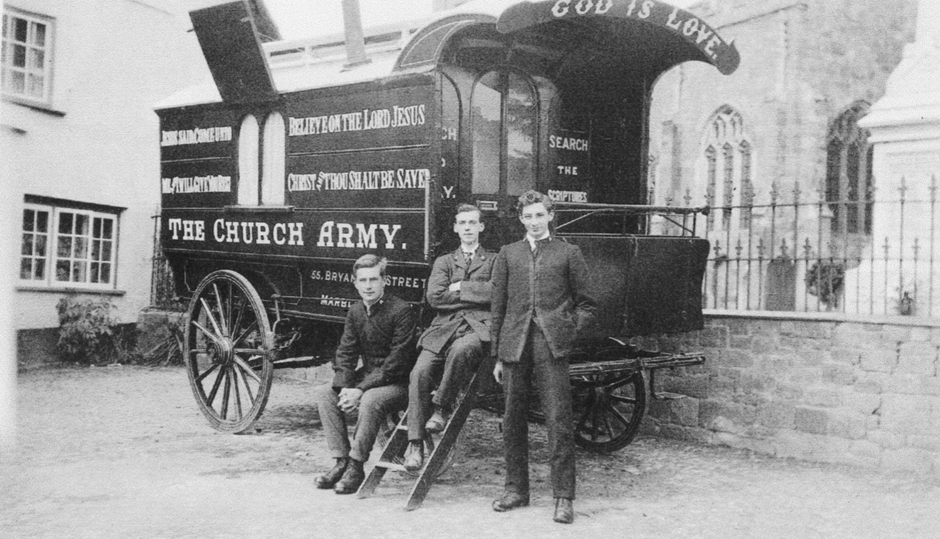
Probably made at the end of the nineteenth century, it bears a label identifying it as a ‘Christophoton’ from the Church Army Lantern Department, based at 130 Edgeware Rd, London. Church Army (not to be confused with The Salvation Army) was founded in London by the clergyman Wilson Carlile (1847–1942). He wanted to bring religion to poorer people who did not normally attend church, and to attract them, he began using magic lantern slide shows during his services. In 1882, he resigned his curacy to start Church Army, which eventually became an evangelical and social improvement arm of the Church of England. Their officers travelled around the country, living in horse-drawn caravans, spending two or three weeks in one area, holding meetings in schools and church halls, illustrating their talks with magic lantern slides. Their Lantern Department produced thousands of glass slides on religious and secular subjects, and loaned out over a million a year in the early 1900s.2,3 A Mission may have come to Woodchurch, as there is a postcard in the Museum’s photo collection showing families sitting outside a marquee labelled ‘Caravan Mission, Woodchurch, 1915’.4
Religious and Social Education
All Saints Church had its own lantern as in 1911, it was ‘thoroughly repaired at a cost of £1 3s 0d […] and as good as new’. A series of eight Lenten lantern services was held following this repair, starting on subjects including ‘The Miracles of the New Testament’ and ‘The Walls of Jericho’, and on Good Friday, a ‘Special Subject’. About twenty to thirty slides were hired and shown at each service. In 1915, the subject on Good Friday was ‘The Cross and Passion of our Saviour’, when the slides shown illustrated the sacred songs and hymns sung by the Choir and congregation.5 On several occasions, William John Bourne, of the building firm W.H. Bourne & Son, is thanked for operating the lantern.
In December 1914, the Woodchurch parish magazine records that a member of the Church of England Temperance Society gave a lecture to the school children on ‘Food’ and later used a lantern in a talk to the Band of Hope meeting about temperance work amongst soldiers and at police courts. The audience of young and old ‘much enjoyed Mr. Fleming’s lively descriptions’. As these must have been aimed at deterring people from imbibing alcohol, one wonders about the level of entertainment involved. In 1915, a lantern was used to illustrate a lecture at the school on the work of the Church of England Waifs’ and Strays’ Society, which later became ‘The Children’s Society’.6
The Coming of Cinema
Magic lantern shows were eventually superseded by the cinema as a form of public entertainment. The first cinema in Tenterden was The Electric Palace in Oaks Road, which was opened in September 1912,7 but lantern use probably continued for some time for lectures and as home entertainment, until the first 35mm slides and projectors were marketed by Kodak in the mid-1930s.8 Given its provenance from Church Army, it may be that our modified lantern from the Memorial Hall was the one originally used at All Saints Church.
Notes and References
- Steve Humphries, Victorian Britain through the Magic Lantern (Sidgwick & Jackson, 1989), p. 22. ↩︎
- Stephen Bottomore, ‘Projecting for the Lord: The Work of Wilson Carlile’, Film History, 14.2 (2002), pp. 195-209. ↩︎
- Photo of caravan from The Church Army website: <https://churcharmy.org/who-we-are/our-history/> [accessed 11 January 2026]. ↩︎
- Photo accession no. 1418, Woodchurch Village Life Museum. ↩︎
- All Saints Parish Magazine for 1911 accession no. A0050, Woodchurch Village Life Museum. ↩︎
- All Saints Parish Magazine for 1914, accession no. A0055; and 1915 accession no. A0057. ↩︎
- ‘The Electric Palace, the Cinema Palace in Tenterden’, My Tenterden, 29 July 2017 <https://www.mytenterden.co.uk/directory/the-electric-palace-the-cinema-palace-in-tenterden-article-250.aspx> [accessed 17 January 2026]. ↩︎
- Kodachrome film was introduced in 1935, initially in 16 mm for motion pictures, followed in 1936 by 35 mm slides and 8 mm home movies film. <https://www.kodak.com/en/motion/page/chronology-of-film/> [accessed 17 January 2026]. ↩︎